
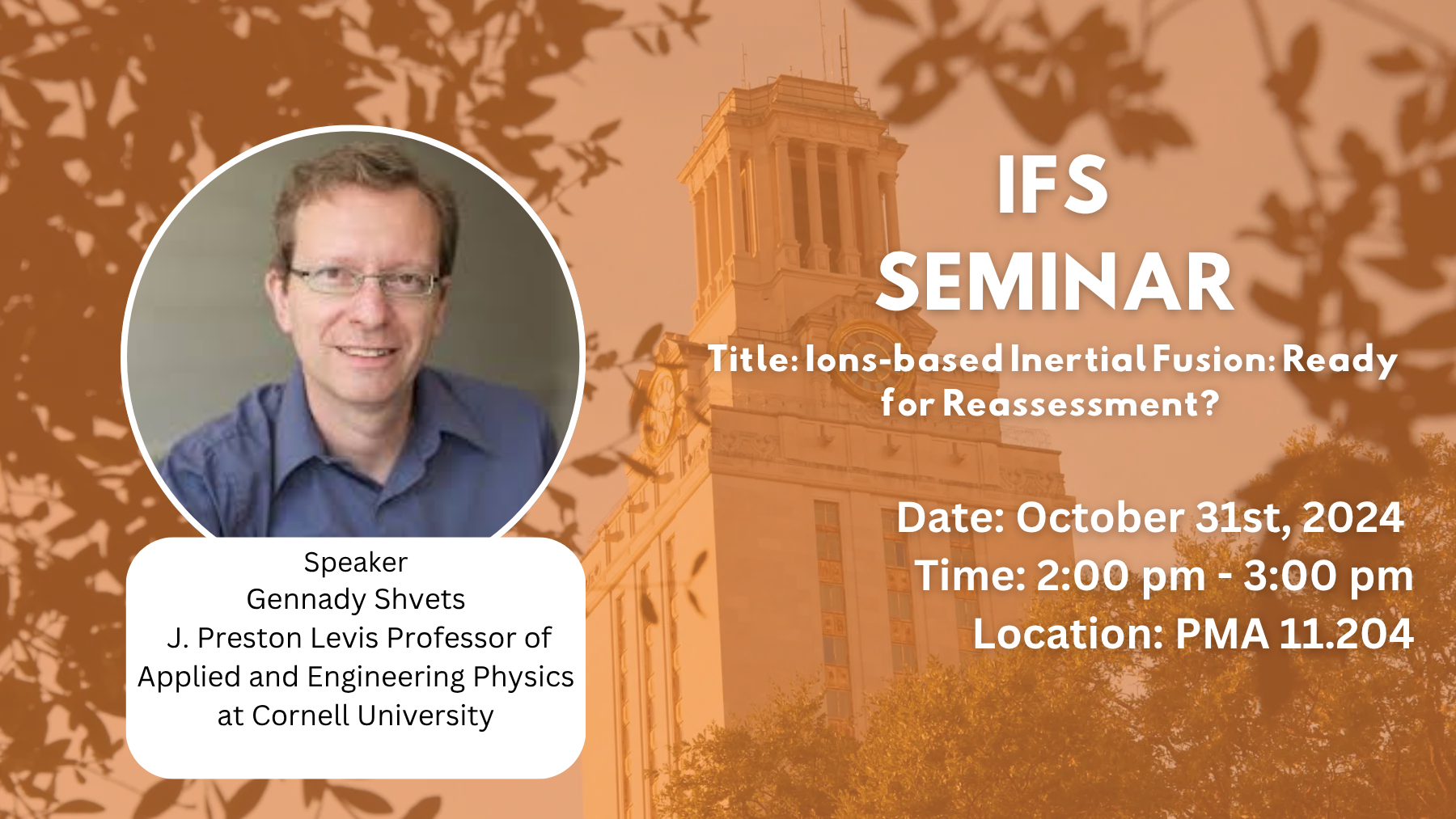
IFS Seminar
Oct
31
2024
Oct
31
2024
Description
Abstract: Research activities on heavy-ion fusion (HIF) have been
abandoned over a decade ago, and brought down to a crawl even much
earlier. It is easy to forget that in the 90’s HIF was considered to be the
top contender for developing inertial fusion energy (IFE). This is not
surprising: accelerator technology is well-established, and the conver-
sion efficiency from a wall plug to accelerated particles is hard to match,
especially at the high repetition rates required for IFE power-plants.
Moreover, unlike most laser fusion schemes, HIF does not require any
damageable optics. One of the often-cited reasons for abandoning HIF
is its non- modular nature: testing even the most basic components,
like ion-heated hohlraums, requires multi-km long induction accelera-
tors. However, high-gradient collective ion acceleration has the poten-
tial for drastic reduction of the driver size – an important step towards
modularity. I will describe the historical context for such schemes and
describe the latest efforts in my group to improve them. Other op-
portunities for fusion-relevant ion acceleration, such as ultra- intense
laser-target interactions for fast ignition of IFE targets, will also be
discussed.