
Fusion research at The University of Texas at Austin began in the early 1960s through a partnership with the Texas Atomic Energy Research Foundation (TAERF), a consortium of ten Texas power companies. Initiated by Physics Department Chair Harold Hanson, this collaboration led to the recruitment of leading plasma physicists and the establishment of a growing experimental and theoretical program.
Significant early support from TAERF and the National Science Foundation enabled the formation of a strong faculty, the launch of innovative experiments—including work on collisionless shocks—and the development of plasma diagnostic expertise. In 1965, Hanson proposed a formal Center for Plasma Physics and Thermonuclear Research, laying the groundwork for what would become a nationally recognized program.
A major milestone was reached in 1971 with the dedication of the Texas Tokamak—one of the earliest university-based tokamaks in the U.S. Operated beneath the Physics, Math and Astronomy Building (then RLM), the Texas Tokamak enabled groundbreaking research in magnetic confinement and plasma behavior, helping establish UT Austin as a key player in the national fusion community. This progress continued with the construction of the larger and more advanced Texas Experimental Tokamak (TEXT). The last iteration of TEXT was dismantled and shipped to China in 2004.
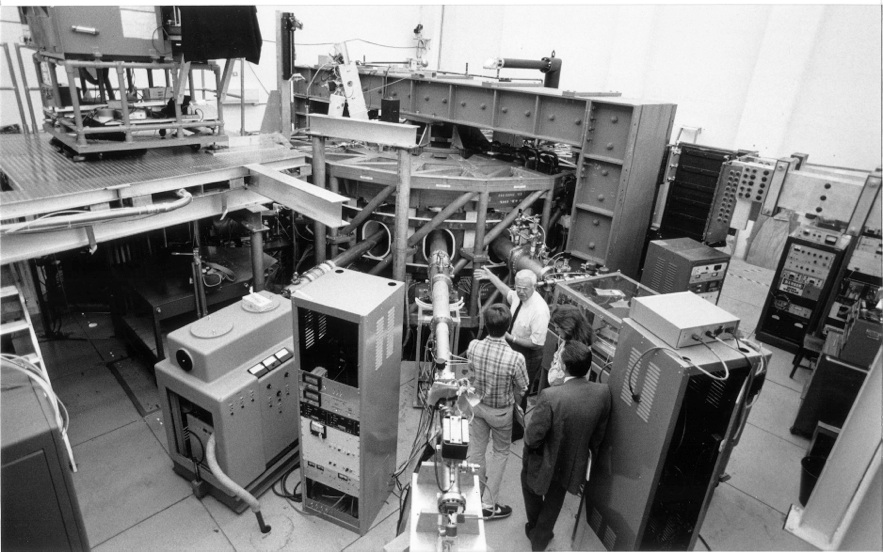
Texas Experimental Tokamak (TEXT) in the Physics, Math and Astronomy Building basement.
The Institute for Fusion Studies (IFS) was established in 1980 in response to a Department of Energy initiative to create a center of excellence in controlled fusion theory. Funded by the DOE and the State of Texas, IFS focuses on the theoretical foundations of fusion and plasma physics—exploring the fundamental principles that govern both stellar and experimental plasmas. IFS played a key role in supporting national fusion initiatives, including serving as the primary U.S. hub for the US-Japan Joint Institute for Fusion Theory.
Currently, the Nuclear Engineering Teaching Laboratory at J.J. Pickle Research Campus supports the newest research reactor in the United States, completed in 1992.