
IFS Seminar
Feb
25
2025
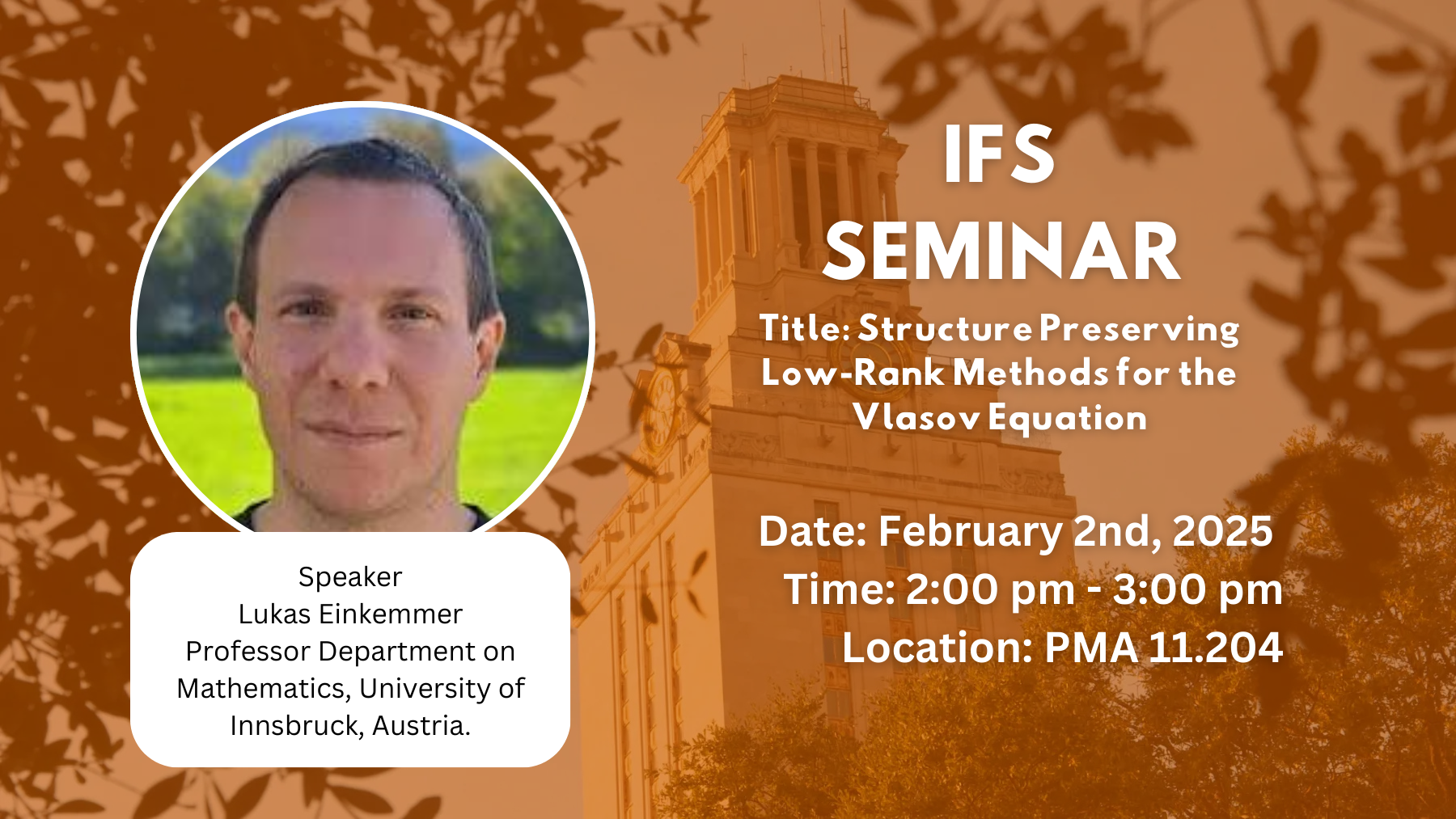
Feb
25
2025
Description
Abstract:
Performing computer simulations of kinetic equations is extremely expensive due to the unfavorable scaling of the number of grid points with dimension (called the curse of dimensionality). To alleviate this often particle in cell schemes are used. However, it is well known that such methods can struggle with phenomena (such as Landau damping) that are relatively easy to resolve using grid-based methods. Moreover, for turbulent problems often a very large number of particles is required for particle methods negating much of their advantage. Recently, dynamical low-rank methods have shown promise for performing such simulations. These methods use an expansion in lower-dimensional basis functions to break the curse of dimensionality, while still maintaining a grid. They can be shown (both theoretical and numerical) to be very effective for a range of problems and we will report on some 6D simulations that have been performed on a single desktop computer. A disadvantage of these methods, however, is that in their original formulation, all the underlying physical structure (e.g. conservation of mass, momentum, and energy, Hamiltonian structure, etc.) are destroyed. This is in stark contrast to more traditional methods (both grid and particle-based) for which methods have been designed that conserve at least some of the physical structure. In this talk, we will report on our recent progress on developing such structure-preserving methods in the context of dynamical low-rank approximation.