
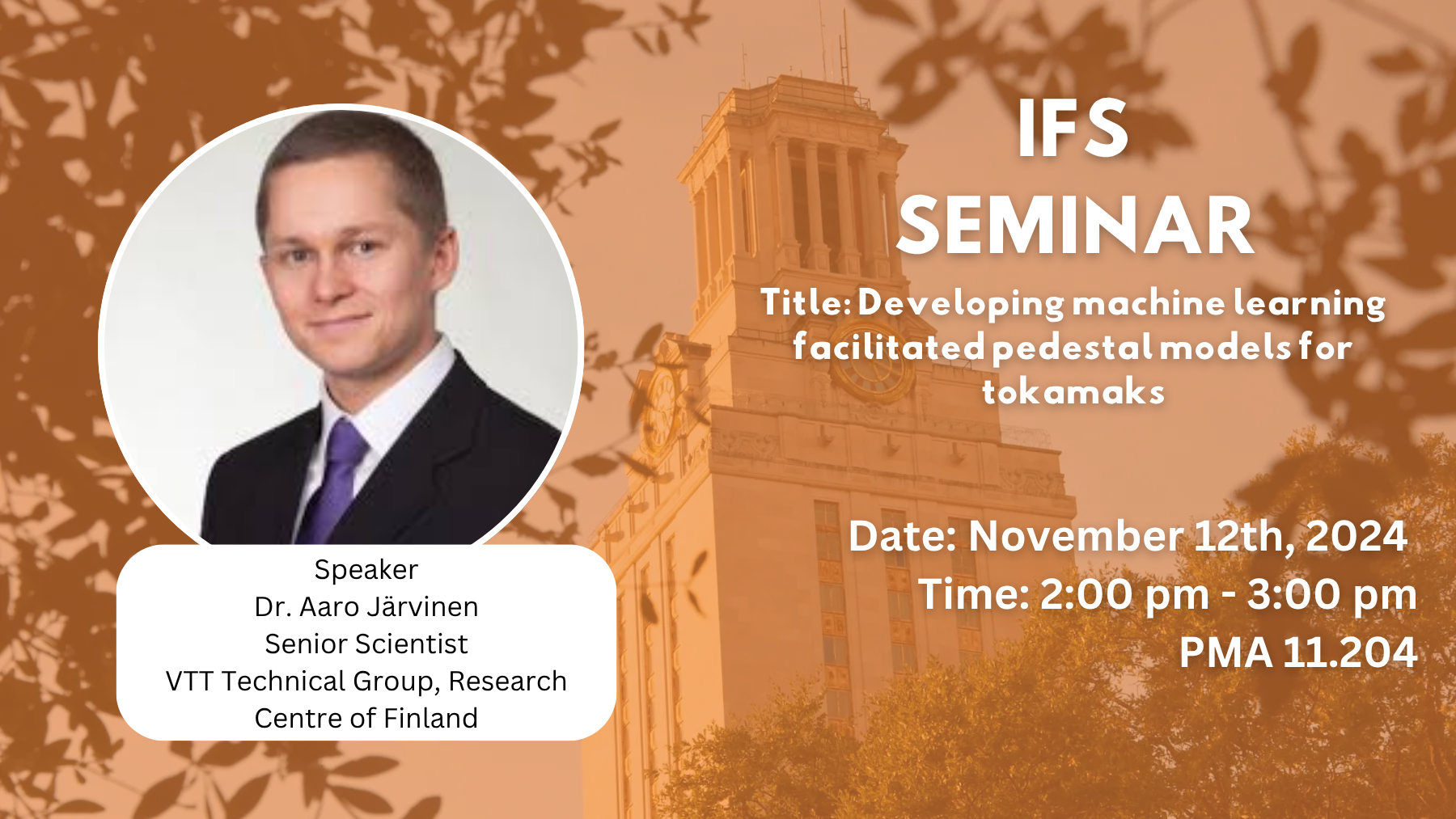
IFS Seminar
Nov
12
2024
Nov
12
2024
Description
Abstract:
The standard high performance operational scenarios in
tokamak fusion reactors are based on a formation of an edge transport
barrier and pressure pedestal at the edge of the plasma. This pedestal
region must enable sufficiently high overall fusion performance, while
also accommodating the necessary power exhaust measures to avoid
overheating of the reactor components. However, due to the multi-
ple relevant physical processes, and spatiotemporal scales, predicting
pedestals is very challenging, and an all-encompassing, high-fidelity
pedestal model does not exist. Hence, models applying simplified
assumptions about the characteristics of pedestal plasmas, such as
primarily limited by features of magnetohydrodynamics, provide
presently the standard method for projecting performance between
scenarios and devices. On the other hand, an integrated, high-fidelity
model would be expected to be prohibitively expensive for agile reactor
design, real-time prediction, or large-scale data-analysis applications.
The development of scientific machine learning (ML) approaches has
opened a pathway to overcome the trade-off between model fidelity and
computational through put as well as to use experimental data to learn
to represent the remaining reality gap in the underlying pedestal models.
This presentation gives an overview of the recent research conducted
by the Fusion ML team at VTT in these ML methods to facilitate
pedestal model development for tokamaks.