
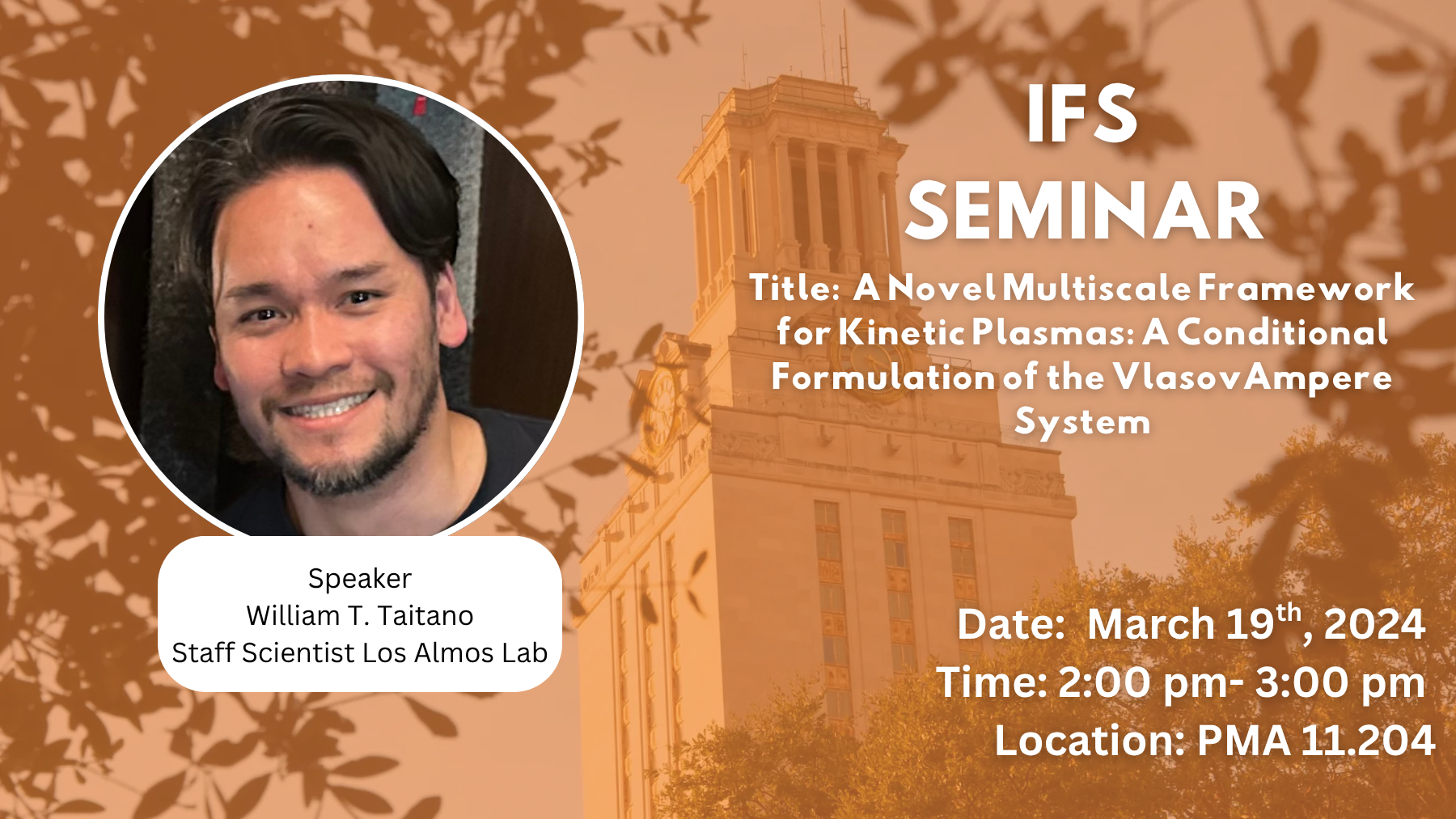
A Novel Multiscale Framework for Kinetic Plasmas: A Conditional Formulation of the VlasovAmpere System
Mar
19
2024
Mar
19
2024
Description
Abstract: The Vlasov equation describes the dynamical evolution
of the plasma particle distribution function (PDF) in the position velocity phase space. When coupled with Maxwell’s equations, the
system is considered the first principles model for describing the complex interactions of plasmas and electromagnetic fields. As such, the equations are used to model a broad spectrum of applications ranging from space weather to astrophysical systems and laboratory fusion de-vices. However, the numerical treatment of the equations remains a challenge; besides the well-known curse-of-dimensionality that plagues the widespread adoption of macroscopic and engineering scale modeling, additional issues exist, stemming from the multiscale and the heavily constrained nature of the equations. The equations support a
reduced order description like quasi-neutrality for vanishing limits of non-dimensional parameters, such as the ratio of the Debye length to macroscopic scales. It becomes paramount for the underlying numerical schemes to preserve these limits when the underlying short length
and time scales are unresolved (i.e., the asymptotic preserving [AP]property). Further, in strongly driven systems such as those containing shockwaves, it is critical to satisfy the different constraints such as conservation, involution (Gauss’s law), and the positivity of the PDF to ensure the solution’s accurate and stable long-term behavior. We propose a novel, yet consistent reformulation of the Vlasov equation based on the conditional distribution function (CDF). The CDF is conditional to the conserved moment priors (e.g., the mass, momen-
tum, and energy densities), and in the new representation, the CDF, together with the moments, defines the state variables. In our formulation, the numerical challenges of simultaneously ensuring the AP property and the myriad of conservation and involution constraints
are shifted from the high-dimensional and integrodifferential Vlasov-Maxwell system into the lower-dimensional moment-field sub-system, where such properties are more readily exposed and satisfied numerically. By using the new formulation, we demonstrate, for the first time in the literature, the ability to simultaneously 1) preserve the quasi neutrality limit, 2) conserve mass, momentum, and energy, 3) satisfy Gauss’s law, and 4) strictly preserve positivity of the PDF for the
electrostatic Vlasov-Ampere system on challenging collisionless shock
problems.