
Computational Methods and Plasma Theory
This research develops advanced computational methods and reduced plasma models to better understand, simulate and predict the complex dynamics of magnetically confined fusion plasmas.
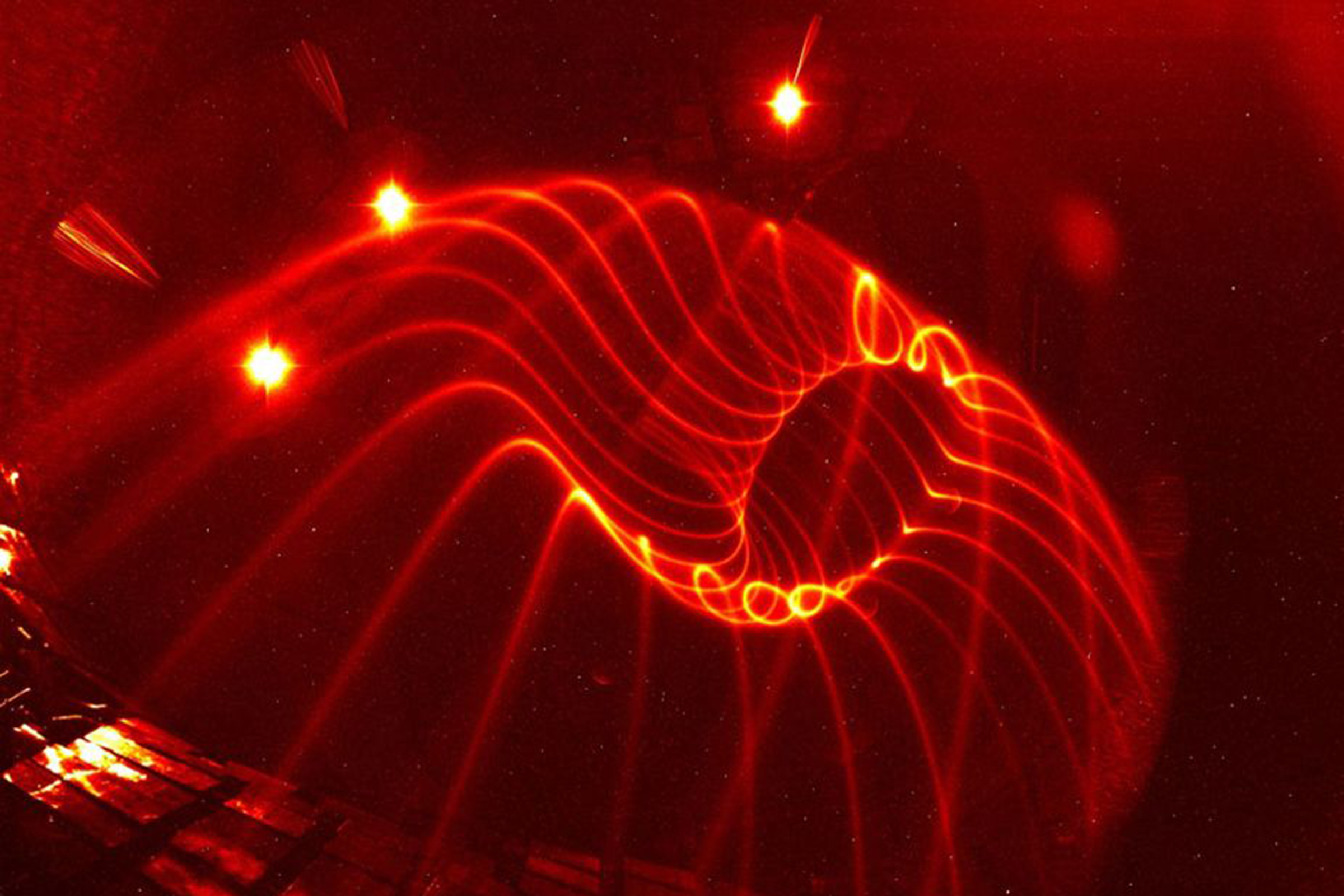
Research in this area targets the development of novel numerical algorithms to meet the computational challenges of the fusion program, and the study of fundamental mechanisms underlying dynamical processes in magnetically confined fusion plasmas. Goals in this area include: (i) probabilistic methods; (ii) semi-Lagrangian algorithms; (iii) Hamiltonian structure-preserving algorithms; (iv) reduced models of plasma-waves interaction; (v) nonperturbative reduced modeling; and (vi) Hall-magnetohydrodynamic turbulence. Specific research goals include the application of the metriplectic framework for the formulation of thermodynamically consistent macroscopic models to produce new fluid and kinetic models including gyrokinetic collision operators. Investigate tearing mode instabilities in stratified plasmas. Reformulate the variational principle to regularize the ideal force balance of MHD equilibria, implement the new model in a 3D solver and study numerical converge under mesh refinement. Identify nontrivial magnetic field configurations in which the nonperturbative guiding center model can be constructed without approximations.